Mini Split Installation in Birmingham, AL
A new system here will heat from November through March and cool from May through September every year. Tell us about the house, and a licensed contractor who covers Jefferson County will get in touch.
Tell us about the job
It takes about a minute.
Ten months a year, your mini-split is working
Jefferson County asks for heat from November through March and cooling from May through September. That is 10 months of the year with barely a break. Winter nights average 35°F. Summer afternoons average 90°F. The unit you install has to handle both ends.
A ductless heat pump manufactured after January 1, 2023 has to meet the same federal minimum as any other split system. That means 14.3 SEER2 for cooling and 7.5 HSPF2 for heating. There is no separate, lower bar for ductless. Ask your installer where the unit you're getting lands against that number.
- 5 months
- November through March, your system heats
- 5 months
- May through September, it cools
- 35°F
- the average winter night it heats against
- 90°F
- the average summer afternoon it cools against
NOAA nClimDiv, 1991–2020 normals
Alabama requires HVAC contractors to hold a state license.
The Alabama Board of Heating, Air Conditioning & Refrigeration Contractors issues this license, and it licenses the contractor, not the specific job. The board tested them and keeps a record of who they are as a business. That record does not attach to the mini-split going in at your house.
For the installation itself, that oversight comes from the local building office instead. In most cities and counties, putting in a mini-split needs a permit and an inspection once the work is done, so someone besides the installer checks the finished job. That inspection is where the connections and the placement get looked at, separate from anything the state license covers.
Source: Alabama Board of Heating, Air Conditioning and Refrigeration Contractors
- Is a mini split worth it?
- For the right room or the right house, yes. A mini split heats and cools without ducts, so it works well for an addition, a garage, or a room that never gets right with the main system. Birmingham homes need heat or cooling most of the year, five months of each, so a unit that does both jobs well earns its keep. Since 2023 these units have to meet the same 14.3 SEER2 cooling and 7.5 HSPF2 heating minimums as any other split-system heat pump, so efficiency is not something you have to weigh against ducted options anymore.
- How many rooms can a mini split cover?
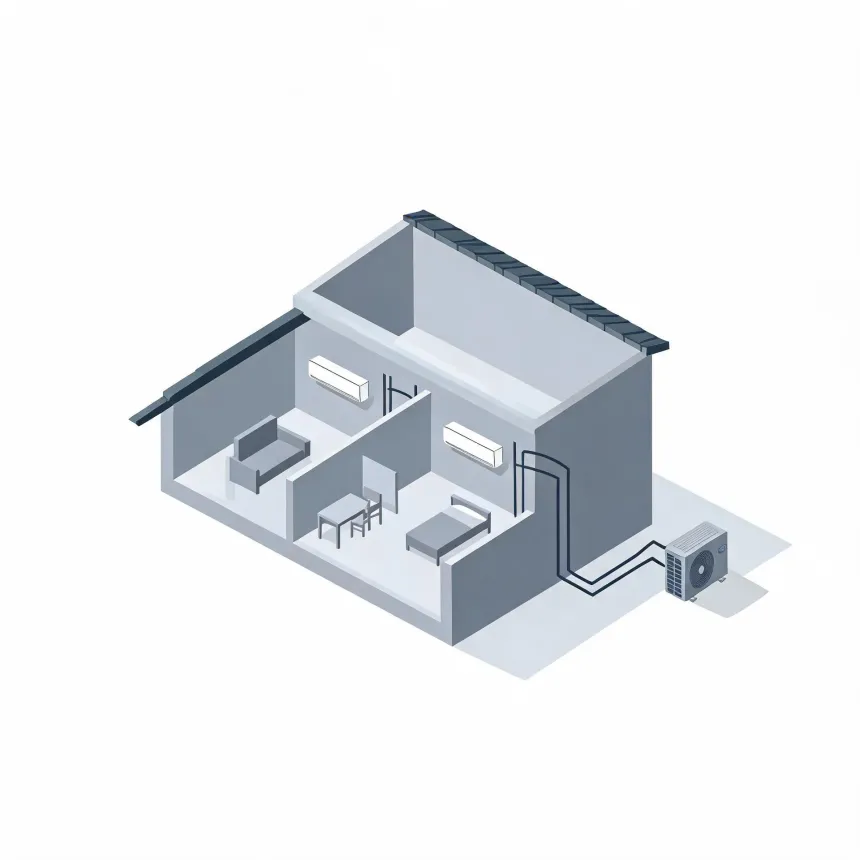
- One indoor head covers one room or one open area well. If you need more than that, a multi-zone system lets one outdoor unit run several indoor heads, each with its own thermostat, so you can cover a few rooms without adding another outdoor unit for each one. How many zones a single outdoor unit can run depends on its size and the load in each room, so a contractor needs to look at the space before saying what will work.
- Can a mini split heat a whole house?
- It can, but it has to be sized and placed for that from the start. A single head warms the room it's in, not the rooms down the hall, so heating a whole house means a multi-zone setup with a head in each area that needs one. On a 35°F night that's a real load, so a contractor has to size the outdoor unit and each zone to cover it, not just the square footage of the house.