Mini Split Installation in Auburn, AL
A new system here will heat from November through March and cool from May through September every year. Tell us about the house, and a licensed contractor who covers Lee County will get in touch.
Tell us about the job
It takes about a minute.
What a mini-split in Auburn has to handle
Ten months out of the year, a mini-split in Auburn is doing something. It heats from November through March, when nights average 37°F, and it cools from May through September, when afternoons hit 90°F. Two months of light duty is all it gets.
A new unit installed here has to meet the federal minimum for a split-system heat pump, 14.3 SEER2 for cooling and 7.5 HSPF2 for heating. With wind events hitting this part of Alabama fifty-two times over the last ten years, and close to a fifth of Alabama households losing power for a day or more in 2024, it's also worth asking your contractor how the system handles a power interruption and comes back once it's restored.
- 5 months
- November through March, your system heats
- 5 months
- May through September, it cools
- 37°F
- the average winter night it heats against
- 90°F
- the average summer afternoon it cools against
NOAA nClimDiv, 1991–2020 normals
Alabama requires HVAC contractors to hold a state license.
The Alabama Board of Heating, Air Conditioning & Refrigeration Contractors tests and licenses the contractor, not each job. That license is tied to the business taking on your work, not to this particular mini-split.
Because the license covers the contractor rather than the job, what checks the mini-split installation itself is the permit and inspection most cities and counties require for this kind of work. That means a local building office reviews the job and inspects it once it is done, separate from whatever license the contractor holds.
Source: Alabama Board of Heating, Air Conditioning and Refrigeration Contractors
- Is a mini split worth it?
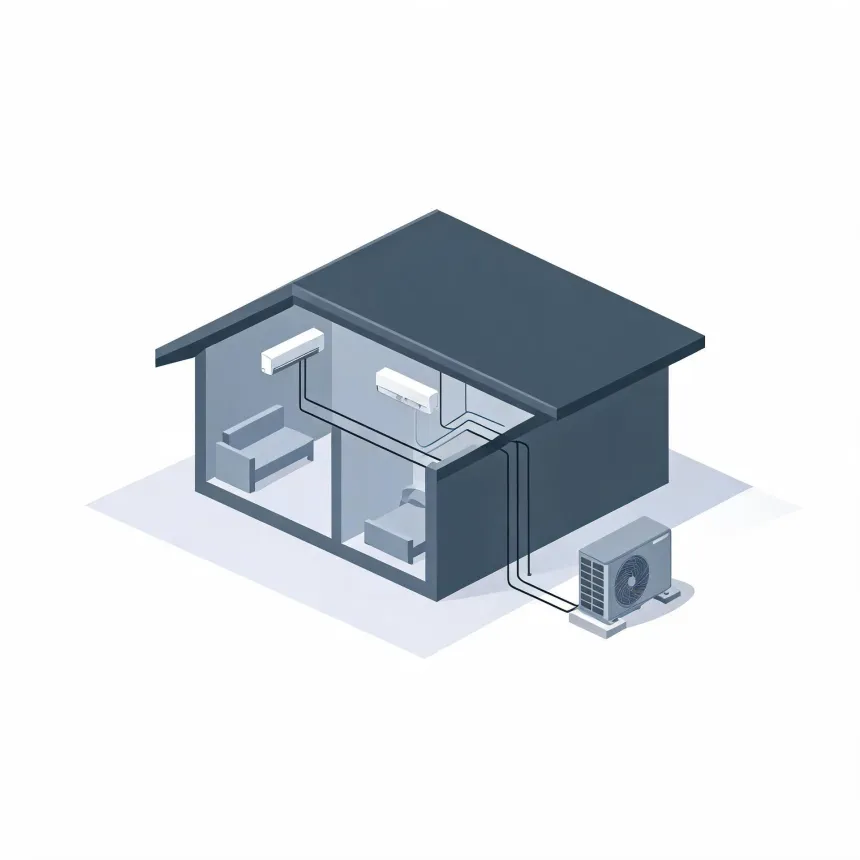
- For most homes, yes, especially if a room runs hot or cold without ductwork to fix it. A mini split heats and cools that one space directly, and it keeps working the same way whether it is 37 degrees outside in winter or 90 in summer. Winters and summers here both run about five months long, so a system that handles both jobs earns its keep most of the year. Have a contractor look at the space before deciding, since the right fit depends on the room and how it is used.
- How many rooms can a mini split cover?
- A single outdoor unit can run one indoor head or several, so it can cover one room or a handful at once. Each indoor head handles its own room or zone, and a multi-zone system lets each one run on its own thermostat. The number that makes sense for a house depends on the size and layout of the rooms, which is something a contractor sizes room by room rather than guessing at.
- Can a mini split heat a whole house?
- It can, if enough zones are installed to reach every room, but a single head is only built to heat the space it sits in. Homes here need heat from November through March, with winter nights averaging 37 degrees, and a mini split is built to keep up with that. Whole-house coverage comes down to how many zones the house needs and where they go, which is a layout question a contractor has to walk the house to answer.