

Sized and installed right
A heat pump matched to your home's load and set up with the right airflow pulls humidity down steadily and holds it there, without long runtimes driving up your electric bill.
You've got a heat pump, or you're thinking about getting one, and you know what Alabama summers feel like. The air sits heavy from June through September, and you've probably had an AC system before that cooled the room but left everything feeling damp anyway. You want to know if a heat pump actually pulls that moisture out, or if you'll be fighting sticky air all summer no matter what's running.
A heat pump cools the same way a central air conditioner does. Warm, humid air moves across a cold indoor coil, and the moisture in that air condenses out and drains away. That's true whether the system is a heat pump or straight AC. The difference that actually matters is sizing. A heat pump that's too big for the house cools the air fast and shuts off before it's run long enough to pull out the moisture, which leaves the house cold and clammy. One sized correctly for the square footage and the duct system will run longer cycles and take the humidity down with the temperature. Getting that sizing right, along with a properly set up duct system, depends on the installation, not the equipment itself.




At 16.09 cents per kilowatt-hour, every degree your heat pump has to fight against costs you something real. A unit sized and installed right pulls moisture out without running longer than it has to. One that's undersized or poorly set up will run constantly trying to catch up, and you'll see that on your bill.
EIA-861 2025 statewide residential average
In your house, this shows up as a thermostat that says 72 while everything still feels damp. You walk in from the car and the air inside doesn't feel dry, it feels cooler but sticky, and that's the sign something's off with how the system is set up, not just how hard it's working. A heat pump that's undersized will hit its temperature setting fast and shut off before it's run long enough to pull the moisture out of the air, so you get a cold room that still feels wet. One that's oversized does the same thing for a different reason, short cycling on and off without ever running the longer, steady cycles that actually dehumidify. Either way you end up reaching for the thermostat again, dropping it a few more degrees trying to chase comfort that temperature alone won't fix, and at 16.09 cents per kilowatt-hour that habit shows up on your bill every month. Musty closets, damp towels that won't dry, a little condensation on the windows, these are what too much indoor humidity looks like in a home that's otherwise cooled just fine.


A heat pump matched to your home's load and set up with the right airflow pulls humidity down steadily and holds it there, without long runtimes driving up your electric bill.
A unit that's too small, or set up without attention to airflow and charge, cools the air but leaves it damp, and runs longer to do even that.


A heat pump doesn't have some separate dehumidifier function. In the summer it works exactly like a regular AC: refrigerant runs through the indoor coil, the blower pulls your warm house air across it, and the coil is cold enough that water condenses straight onto the fins. That water drips into a pan and runs out through a condensate line. The moisture never goes anywhere near the ductwork or the thermostat. It leaves through a drain.
What decides how much moisture comes out is runtime and airflow, not the refrigerant itself. A coil that stays cold and wet for a longer stretch pulls more water out of the air passing over it. That's why a two stage or variable speed compressor, running longer at a lower output instead of blasting on and off, does a better job on humidity than a single stage unit that satisfies the thermostat in a few minutes and shuts down. Same logic on the blower. Slower fan speed means the air spends more time against the coil before it moves on.
Size works against you if it's wrong. A coil sized too big for your house will cool the air fast and hit the thermostat setpoint before enough time has passed for real moisture removal. The house reads cool and still feels damp.
The reversing valve, the part that lets the system switch to heating in winter, plays no role in any of this. All the dehumidifying happens on the cooling side, same as it would with a straight AC.



You're out in the side yard in April, grass still wet from the night before, and you crouch down to check the outdoor unit before the first real hot stretch hits. Rust has crept along the base of the cabinet, the kind that builds up over years of Alabama humidity sitting against the metal. The fan spins up fine when the thermostat calls for it, but you notice it running longer than it used to. A tech who works this equipment every summer would know from that rust line alone roughly what's gone on inside the coil, and whether the unit's still sized for what your house needs now.
Getting a heat pump sized right for Alabama humidity isn't a job for whoever picks up the phone first. It means finding someone who installs and services these systems in homes like yours, season after season, and knows what a poor install looks like six months later. That usually means calling around, explaining the same thing about your house and your old system three or four times, then trying to compare quotes that aren't even quoting the same work. You end up guessing which contractor actually knows heat pumps versus one who mostly does gas furnaces and takes this job to stay busy. A request through this page goes to one local contractor who works on this equipment regularly, not a handful of companies competing for the callback. You explain your situation once. With power here running 16.09 cents a kilowatt-hour and humidity a daily fact of life from June through September, getting the sizing and setup right the first time matters more than finding someone fast.

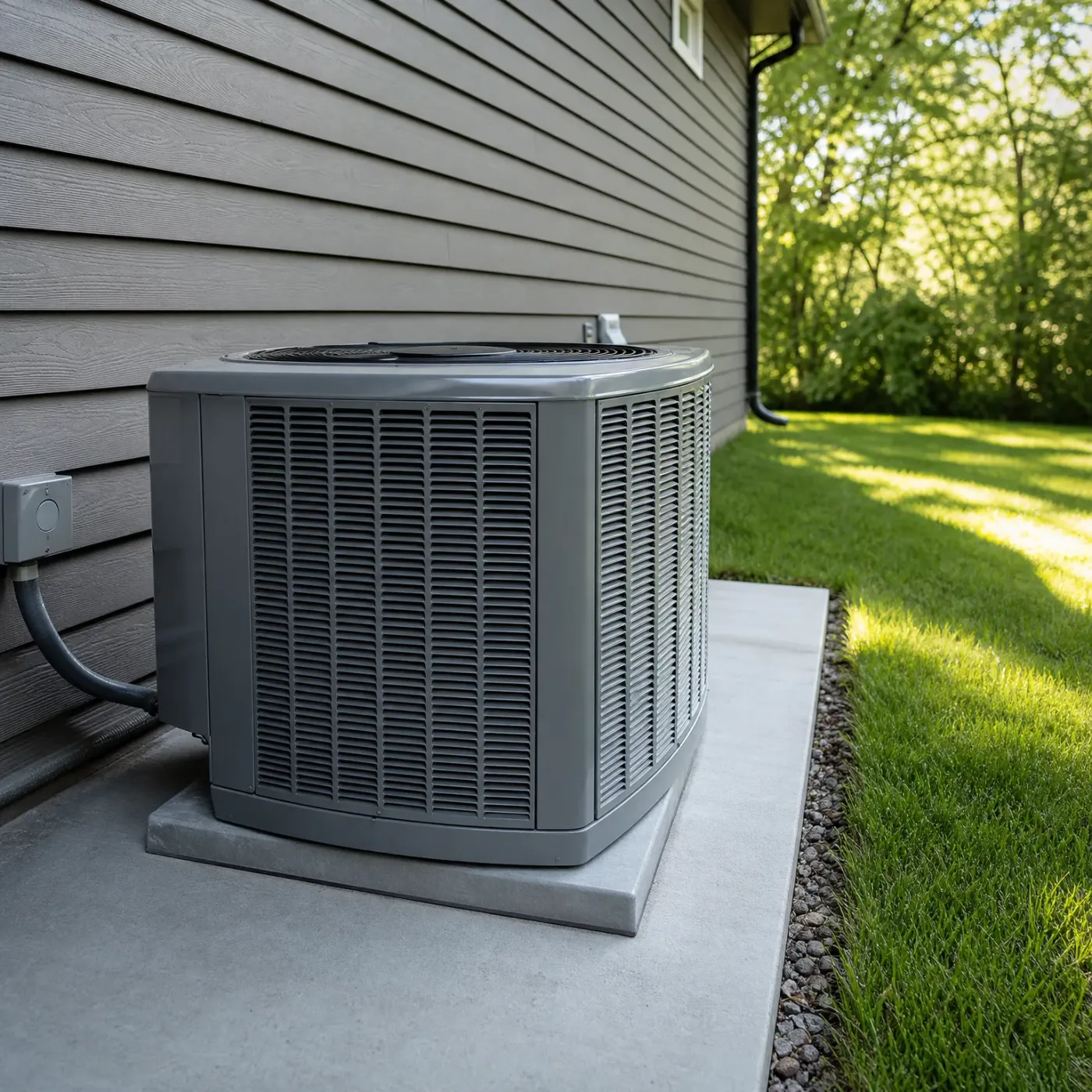
The lines and conduit run straight to the disconnect, and the pad underneath is clear. Mulch and a small shrub sit nearby but nothing crowds the cabinet. Airflow around the coil stays open, which is what lets it pull moisture out without straining.

Weathering and dust have settled into the fins on this one, and that cuts into the airflow the coil depends on. A unit working this hard against its own buildup runs longer to cool the house and does less to pull the humidity out while it does.
You notice it on the couch, not the thermostat. The number reads 71 and you've still got a sheen on your skin, the sheets feel damp, the wood floor in the hallway has that faint stickiness under bare feet. Windows fog on the inside near the kitchen in the early morning. You run the system longer, hoping it catches up, and the house still doesn't feel dry. That's moisture the system isn't pulling out, not a temperature problem. Left alone through a full Alabama summer, that extra moisture gives mold and mildew a place to start, along the baseboards, in closets, behind furniture against an outside wall, and it keeps your electric bill climbing for comfort you're still not getting.
A dew point is what makes the air feel heavy instead of just warm, and across an Alabama summer it averages 69°F. That's thick air for a coil to work against all day. A heat pump sized and installed right keeps pulling water off that coil at a steady pace, even when the dew point sits in the high 60s for weeks at a stretch. One that's undersized has to run longer to chase the same humidity, and the coil can't keep up, so the air coming out feels cool but not dry. You'd notice it as a house that never quite loses that damp feel, no matter where you set the thermostat. Source: NOAA climate normals
NASA POWER T2MDEW county cells weighted by homes
Load calculation sets the size for your home's square footage and heat gain.
Ductwork gets checked for leaks and airflow before the new unit goes in.
Indoor coil and outdoor unit get matched so refrigerant charge is correct.
Refrigerant lines get connected, pressure tested, then evacuated to pull out moisture.

That's the whole answer. The equipment works the way it's supposed to when the load calculation matches your house, the ductwork moves air the way it should, and the refrigerant charge is set correctly at install. Get that right and the unit pulls moisture out steadily through a long Alabama summer without running up your electric bill chasing a number on the thermostat.
Finding someone to do that part right is the actual work in front of you now. Instead of calling around to a handful of companies, explaining your situation to each one, and trying to compare quotes that are not quite measuring the same job, you're matched with one licensed contractor local to Alabama, someone who installs and services these systems through the same humid summers you live with. You get a straight answer about your house, from someone who already knows what usually goes wrong here.

The pro who reaches out is licensed in Alabama.
Sending the form costs nothing.