Musty smell from vents in Tuscaloosa, AL

A galvanized metal round duct with a 90-degree elbow connected to a rectangular louvered vent grille, shown against a plain gray background.
Get a duct system pro

A musty smell from your vents usually means moisture sitting somewhere in the duct system, often on the evaporator coil or in the ductwork itself. Tuscaloosa summers stay muggy for months, and your AC pulls a lot of that moisture out of the air as it cools your house. Some of it should drain away through the condensate line, but if that line is clogged or the coil stays wet between cycles, mold and mildew start growing right where your air passes through. Dust and debris built up in the ducts give it something to feed on. Once that smell is in the system, it comes through every vent in the house, not just one room, and it tends to get stronger the longer the AC runs. A dirty filter can make it worse by slowing airflow and keeping the coil wetter longer. The smell itself is not something a filter change fixes if the growth is already inside the ducts or on the coil.

An older man with gray hair and a beard, wearing a dark jacket dusted with snow, stands smiling in a dimly lit hallway with lamps and a living room visible behind him.
A gray-haired, bearded man in a dark snow-dusted coat stands smiling in a dimly lit entry hall with a staircase, a lit table lamp, a framed picture, and a living room visible through a doorway.
An older man with white hair and a beard, wearing a dark snow-dusted coat and scarf, stands in a warmly lit interior hallway with a framed landscape picture, a table lamp and a potted plant behind him, and a snowy view through a window at left.
A gray-haired, bearded man in a dark coat dusted with snow stands smiling in a dimly lit room with a lamp, mirror, framed art, and a sofa in the background.

Why does this smell keep coming back in Tuscaloosa?

  • Half the homes here were built by 1992

    Half the homes in Tuscaloosa County were built in 1992 or earlier, half in 1992 or later. Older ductwork has had more years to collect dust that holds moisture and feeds the smell.

  • Heat runs November through March

    Cooling runs May through September here, about five months straight. That's five months of condensation on the coil, and five months for anything damp in the ducts to turn musty.

  • Cooling runs May through September

    Heat runs November through March, roughly five months. Vents sit closed up and still that whole stretch, which gives any trapped moisture time to sit and settle into the ductwork.

ACS 2020-2024 · NOAA nClimDiv 1991-2020

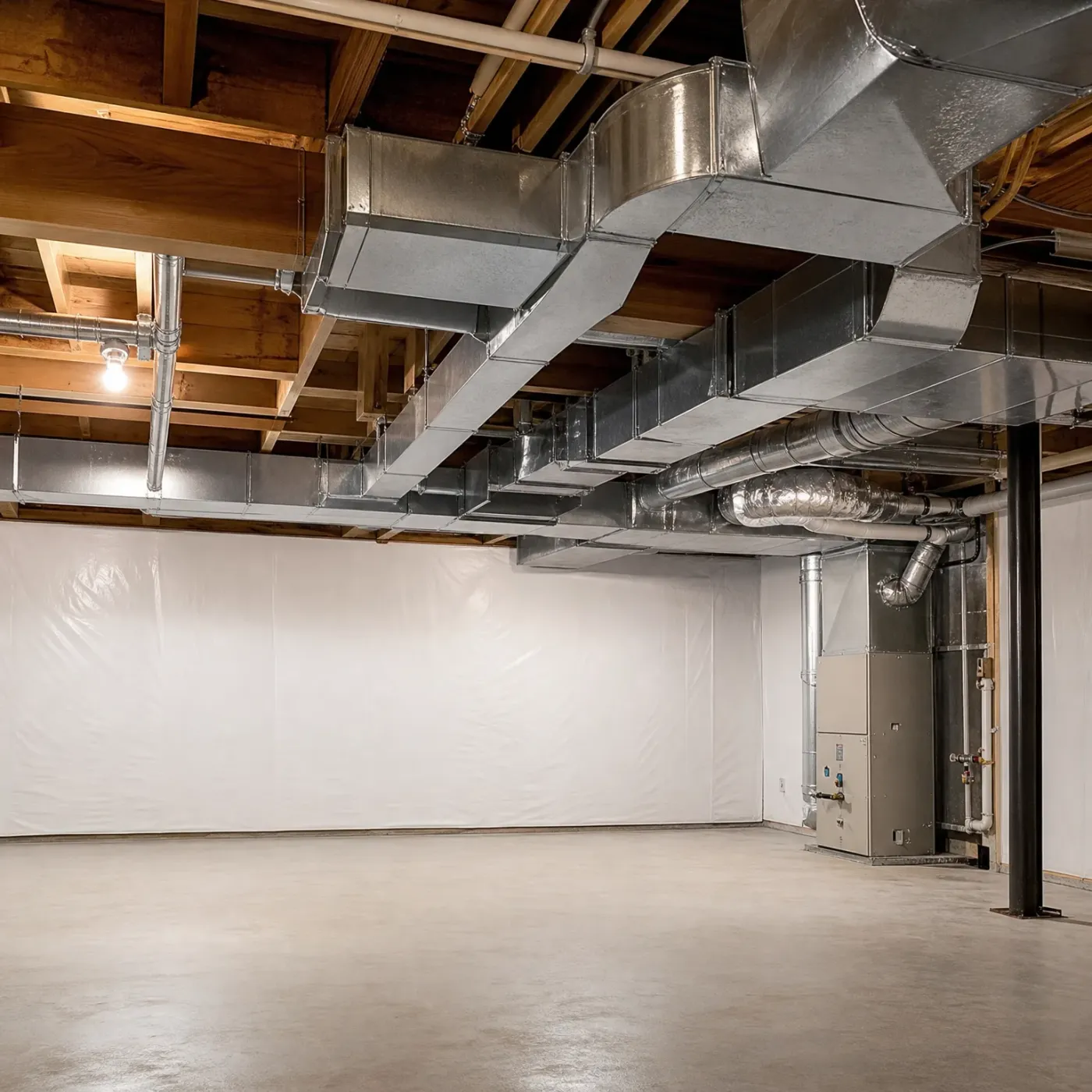
Empty basement with bare concrete floor, white plastic sheeting over one wall, exposed wood joists, galvanized sheet-metal ductwork and pipes overhead, and a furnace unit with a steel support column at right.

Clean, dry ductwork

Metal stays dry to the touch and the air moving through it carries no odor. Dust sits as a thin film instead of a damp coating. The vapor barrier on the walls is doing its job, keeping ground moisture out of the space the ducts run through, so there's nothing nearby for the system to draw in.

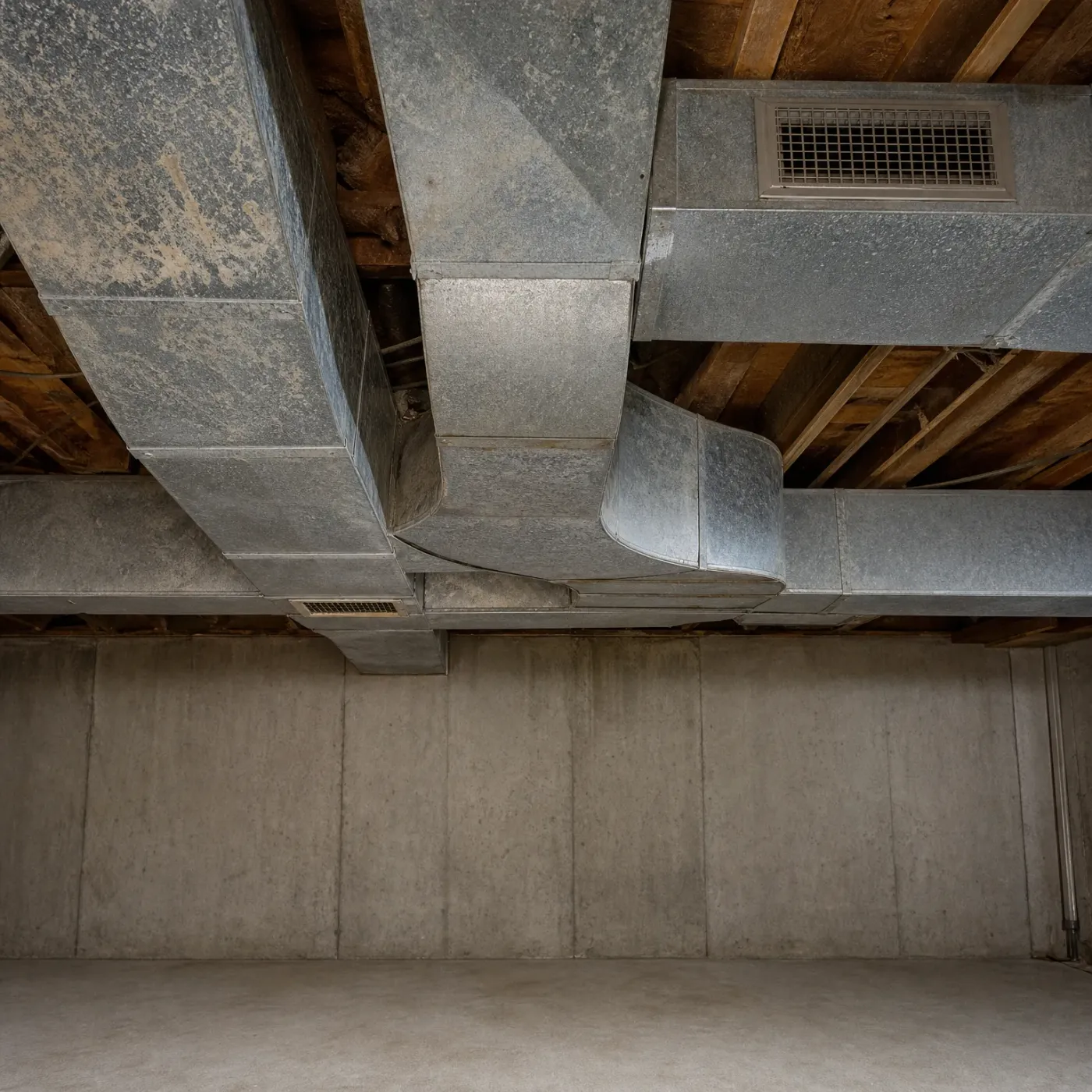
Galvanized sheet metal HVAC ducts with vent grilles run along a wooden floor joist ceiling above bare concrete walls and floor in an unfinished basement.

Ductwork holding moisture

Bare concrete walls and floor let moisture into the air around the ducts, and the metal seams and joints pick it up. That dampness mixes with dust inside the duct and sits there between cycles. Every time the system runs, it pushes that smell out through the registers in the rooms above.

A man with a duffel bag walks up a concrete path toward a white board-and-batten house where a woman stands in the open wooden front door, flanked by potted plants and black lanterns.

What that smell is doing to your house while you wait

Every time the system cycles on, that musty air moves into whatever room the vent feeds. A bedroom, a home office, wherever the ducts run. You smell it most in the rooms you spend the most time in, which is its own kind of unfair. Guests notice it before you do, because you've been breathing it long enough to stop registering it.

Left alone, the moisture behind the smell doesn't stay put. It feeds more dust, more growth, more of the same smell, and it can start affecting the metal and insulation around it. A contractor who works on duct systems around Tuscaloosa every summer has seen what a few years of this looks like inside the ductwork, and knows where to check first in a house like yours. Getting matched with one means someone local looks at your system specifically, not a general checklist, and calls you to talk about what they'd do.

A shallow dark wooden bowl and a stack of books rest on a wooden table in front of a beige sofa with linen and green cushions, with a tall ceramic vase of thin branches beside a window in the background.
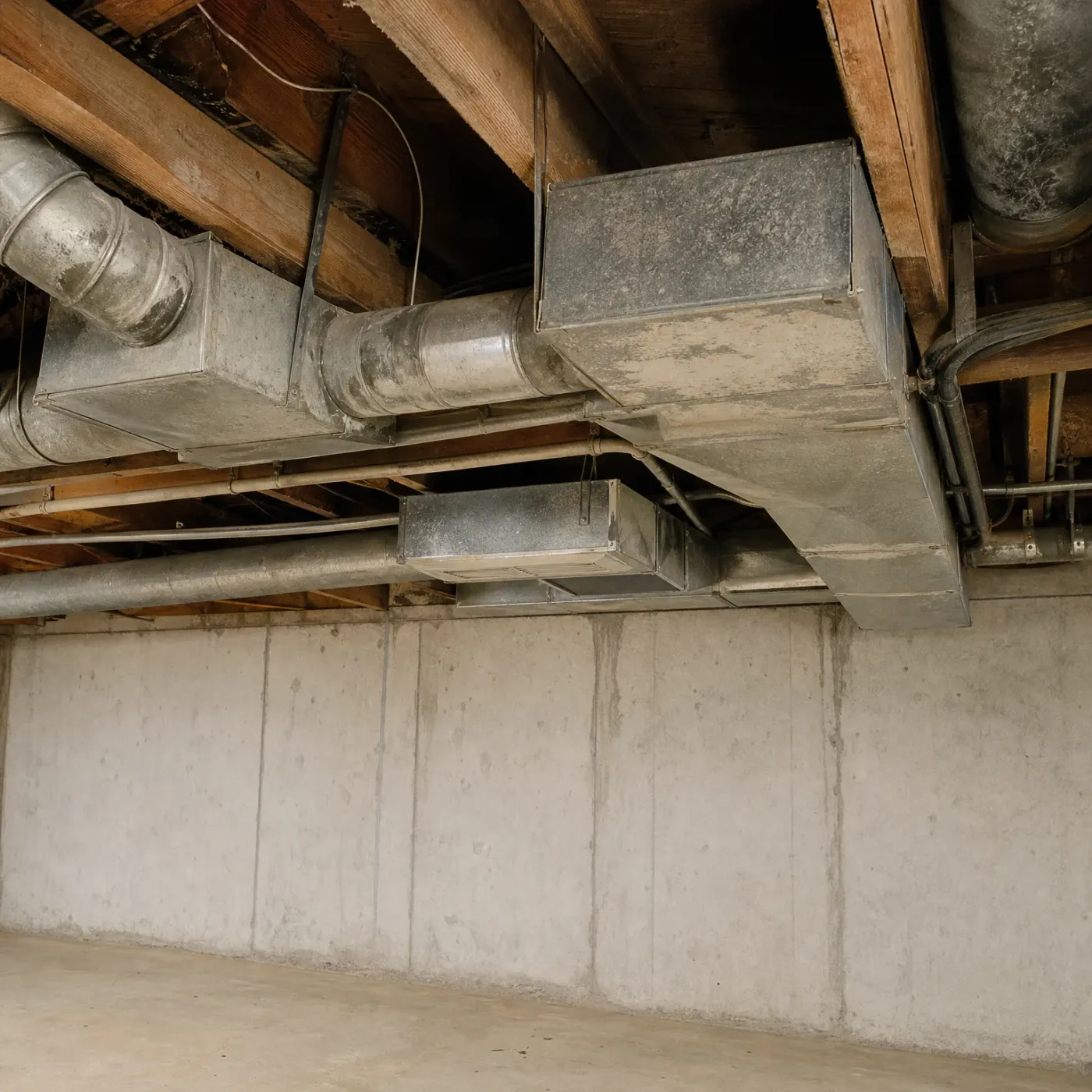
Unfinished basement with poured concrete walls, a bare concrete floor, white PVC pipes running down the wall, and exposed sheet-metal HVAC ductwork beneath wood floor joists.

Dry ducts, dry basement

The concrete floor here is sealed and the walls are poured solid, so ground moisture stays outside where it belongs. The metal ducts and pipes run through dry air, not damp air, so there's nothing around them to hold a musty smell in the first place.

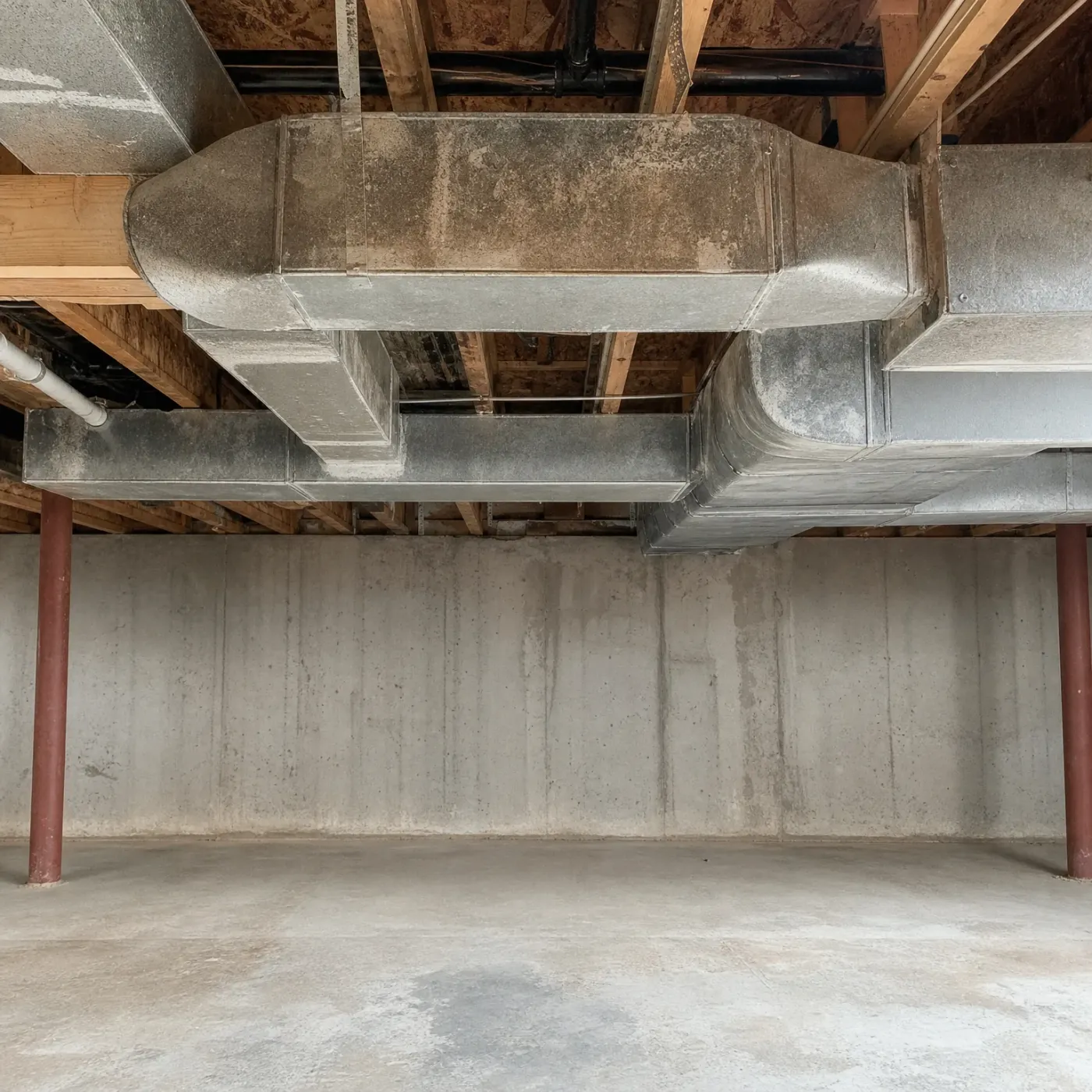
Unfinished basement with bare concrete walls and floor, galvanized sheet-metal HVAC ducts running beneath wooden floor joists, and two red steel support columns.

Ducts hung in damp air

These ducts run under open joists with the foundation walls exposed and no barrier against ground moisture. That moisture sits in the air around the metal, and the ducts pull it in and hold it, which is where the smell coming through your vents gets its start.

What part of the system actually causes the musty smell?

You want to know what you're actually dealing with before you call anyone, not just a general idea that it's "moisture somewhere."

The evaporator coil, almost always

The evaporator coil sits inside the air handler, and it stays wet for as long as the AC runs. That's its job, pulling moisture out of the air. Dust in the house settles on the wet coil fins and stays there, feeding mold and bacteria that give off the musty smell. A tech who works on these systems every summer checks the coil first, because a dirty, wet coil causes this far more often than the ductwork itself. The drain pan underneath can hold the same problem if water sits in it instead of draining out the condensate line the way it's supposed to.

Empty basement room with bare concrete walls and floor, and an exposed wood-joist ceiling carrying sheet-metal ductwork, insulated pipes, and recessed lights.
Ducts like this stay dry because the slab underneath is sealed, so no groundwater vapor works its way up into the joist bay.
Basement ceiling with galvanized sheet metal ductwork, round pipes and rectangular plenums running between wooden joists above a bare concrete foundation wall and floor.
Condensation and dust have turned the metal damp here, and that film is what grabs the smell and holds it.
Dim interior corner of a room with a ceiling air vent, a beige wall, a cream curtain beside a window showing bare trees, and a dark ceramic vase of flowers on a wooden side table behind a light upholstered sofa back.

It's a Saturday afternoon in April and you've got the windows cracked because the air outside finally feels decent. The AC kicks on anyway, just enough to pull the humidity down, and that same smell drifts into the living room. You look up at the ceiling vent and the grille has a soft gray coat of dust on it, thicker than you remembered. On the side table underneath, the lamp and the stack of mail have a film on them too, fine enough that you only notice when the afternoon light hits it sideways. You run a finger across the coffee table and it comes back dusty. The smell isn't strong, but it's there every time the system runs, and now you're looking at the vent instead of the TV.

Get matched with a duct system pro in Tuscaloosa County

A musty smell that keeps coming back after the filter's been changed and the vents wiped down usually means something inside the system is staying wet between cycles, and that's not something you can see or reach from a vent cover. It takes someone pulling the coil, checking the drain line, and getting into the ductwork itself to find where the moisture is sitting. A contractor who works on Tuscaloosa County systems through a full summer of humidity like this one sees the same handful of causes over and over, a clogged drain pan, a coil that never fully dries between cycles, insulation that's stayed damp since last August. One contractor gets your request, not several, so you're dealing with someone who can actually look at your ducts and tell you what's growing in them, rather than guessing over the phone. That's the difference between masking the smell again and being done with it before next summer's humidity sets back in.

Why the coil gets hit hardest

The evaporator coil sits in the path of every bit of air your system pulls out of your house before that air ever reaches a duct. As it cools the air, moisture collects on the coil's fins, and a lot of it drips away into the condensate line. Some stays behind as a film on the metal. With cooling running from May through September in Tuscaloosa, that coil rarely gets a stretch long enough to dry out all the way. Dust riding the airflow sticks to that film, and the two together are what you're smelling, not the ductwork itself most of the time.

Why the smell outlasts a clean filter

Changing the filter stops new dust from reaching the coil, but it does nothing for what already built up there over the summer. A filter catches particles moving through the airflow, it doesn't dry anything or remove what's already stuck to metal. The coil sits behind the blower, out of reach from any vent cover, so wiping down the registers in your bedroom or living room never touches the actual source. That's why the smell can fade for a few days after a filter change and then come right back once the system cycles enough times to push air across that same damp coil again.

A woman wrapped in a thick fleece blanket sits on a sofa holding an open book, beside a lit table lamp and a frost-covered dark window.
A woman in a cream knit sweater sits in an armchair indoors, eyes closed and smiling, beside a window showing yellow and orange autumn foliage, with a mug on a wooden side table and shelves holding vases behind her.

Duct cleaning alone

Clears the dust and film built up in the ductwork, but if the evaporator coil is still holding moisture between cycles, the smell usually comes back within a season.

Get a licensed local pro

Coil and duct cleaning together

Addresses the moisture source on the coil along with the ductwork, so there's nothing left behind to grab onto and start the smell again.

Get a licensed local pro

Power here costs 17.62 cents per kilowatt-hour

Power in Tuscaloosa County runs about 17.62 cents per kilowatt-hour, among the higher rates homeowners deal with. That matters here because a system fighting a musty coil or damp ductwork works harder and longer to cool the house, and every extra hour it runs shows up on that bill.

EIA-861 2025

What this comes down to

  • A musty smell from your vents almost always traces back to moisture on the evaporator coil or sitting in the ductwork.
  • Tuscaloosa summers run long and humid, and the coil stays wet between cycles unless it gets cleaned.
  • Duct cleaning alone clears the dust, but the smell comes back within a season if the coil still holds moisture.
  • A licensed local contractor who works on these systems all summer knows whether the coil, the ducts, or both need attention.
  • One contractor gets matched to your situation, so you deal with a single call back instead of several competing estimates.
  • Getting the coil and ducts cleaned together addresses both the smell and the extra strain pushing up your power bill.

A musty smell from your vents in Tuscaloosa is moisture, almost always sitting on the evaporator coil or in the ductwork, and the long humid summers here give it plenty of chances to take hold. Wiping down vents or changing the filter won't touch it, because the source is further back in the system where you can't see it. Duct cleaning helps with the dust and film, but if the coil is still wet between cycles, the smell is back before the season's out. Getting both done together is what actually closes the loop, and it takes the strain off a system that's otherwise working harder and longer just to keep the house cool.

This isn't a guess-and-check job. A contractor who services AC systems through a Tuscaloosa summer has seen this exact complaint enough times to know where to look first, whether that's the coil, the ductwork, or both. When you put in a request here, it goes to one licensed local contractor, not a handful of companies bidding for the job. That means one call back, from someone who already has a sense of what's likely going on before they show up, instead of sorting through several strangers making the same guesses.

The smell itself is a signal, not the problem. It's telling you there's standing moisture somewhere in a system that runs most of the year here. Once that moisture is dealt with, the smell goes with it, and the system stops working against itself every time it cycles on.

A dark-clad house with large windows beside a gravel driveway lined with in-ground path lights, ornamental grasses and hydrangeas, with distant hills and an orange sunset sky.

Ductwork Cleaning

A duct system pro near you

Duct and vent cleaningDucts or ventsTuscaloosa County, AL
Step 1 of 2

What ZIP code is the job in?

  • A beige upholstered armchair with a cushion and knit throw sits beside a double-hung window with a woven shade, next to a white fireplace mantel with a lit fire, a vase of greenery, and a round wooden table in the foreground.
    • Say what's going on with your ductwork, and a pro who works on them reaches out.
    • Your duct cleaning request goes to a local pro who does this work.
  • A shallow speckled beige ceramic bowl holding a leafy green branch sits on a wooden dresser beside a tall matte stoneware vase, with a window at left and a dark-framed picture at right.
    • Send it once and finding someone is no longer on you.
    • Send the form and finding a duct cleaner is handled.
  • A ceramic table lamp with a pale tapered fabric shade sits on a rustic wooden table beside a wooden bowl, with a framed artwork on the beige wall and sunlight from a window at left.
    • Skip searching for someone who cleans ducts in Tuscaloosa County.
    • Fill out one short form instead of calling around.
  • A black box-shaped outdoor wall lantern with seeded glass panels and a lit filament bulb mounted on a light gray board-and-batten exterior wall, beside a dark-framed glass door, with green leafy shrubs in the foreground.
    • Your request stays with one local pro.
    • Your duct cleaning request goes to one local pro.