Mini Split Installation in Huntsville, AL
A new system here will heat from October through April and cool from May through September every year. Tell us about the house, and a licensed contractor who covers Madison County will get in touch.
Tell us about the job
It takes about a minute.
A mini-split here works almost the whole year
Your mini-split will run from October through April to keep the house warm, then May through September to keep it cool. That's 12 months of the year with almost no break, on nights near 33°F and afternoons near 88°F. Whatever you install has to hold up to both ends of that range, not just one.
Any new mini-split manufactured now has to meet 14.3 SEER2 for cooling and 7.5 HSPF2 for heating, so that baseline is already set. What matters more here is the power behind it. Most homes in Alabama heat with electricity, and county records show 9 winter storms and 431 damaging wind events over the past ten years. When the power goes out, a mini-split goes with it, so how it gets installed and wired matters as much as the unit itself.
- 7 months
- October through April, your system heats
- 5 months
- May through September, it cools
- 33°F
- the average winter night it heats against
- 88°F
- the average summer afternoon it cools against
NOAA nClimDiv, 1991–2020 normals
Alabama requires HVAC contractors to hold a state license.
Alabama's board tests contractors before they hold this license, and it covers the contractor, not the job in front of them. When someone comes to install your mini-split, what's licensed is them, backed by a test they passed and a record the board keeps.
The installation itself still gets checked at the local level. In most cities and counties, a job like this needs a permit from the building office and an inspection once the work is done. That's where the line set and electrical connections get looked at, separate from the state license.
Source: Alabama Board of Heating, Air Conditioning and Refrigeration Contractors
- Is a mini split worth it?
- For the right room or the right house, yes. A mini split heats and cools without ducts, so it works well for additions, garages, or older homes where running ductwork is not practical. Here, it has to earn its keep both ways, since homes need heat from October through April and cooling from May through September. A modern unit meets the same efficiency minimums as any ducted heat pump, 14.3 SEER2 for cooling and 7.5 HSPF2 for heating, so you are not giving up efficiency by going ductless.
- How many rooms can a mini split cover?
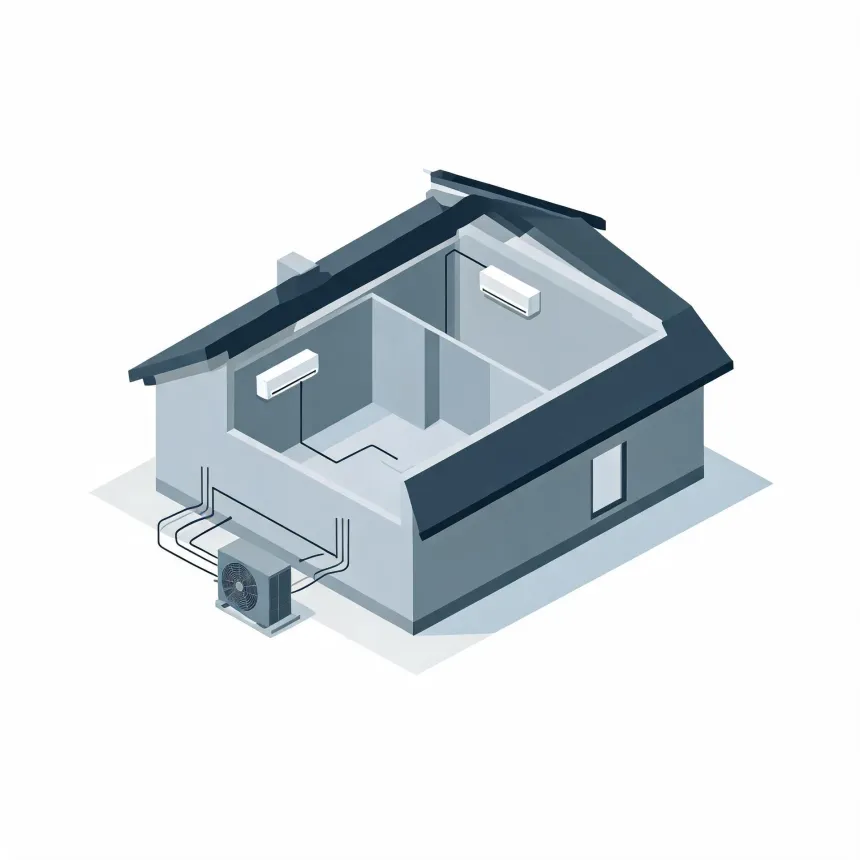
- A single indoor unit is built for one room or one open space. If you need to cover several rooms, a multi-zone system lets one outdoor unit run several indoor heads, each with its own thermostat. How many rooms make sense depends on the size and layout of each one, so a contractor sizing the job will look at the actual house rather than guess at a number.
- Can a mini split heat a whole house?
- It can, if it is sized and placed to cover every room, but that usually means a multi-zone system rather than one unit. Winter nights here average 33°F, so the heat pump needs to be rated for that kind of cold and sized to keep up through the coldest stretch. A single indoor head heats the room it is in well but will not carry rooms down the hall, so a whole-house job takes planning around the layout of that specific house.