Mini Split Installation in Anniston, AL
A new system here will heat from November through March and cool from May through September every year. Tell us about the house, and a licensed contractor who covers Calhoun County will get in touch.
Tell us about the job
It takes about a minute.
What an Anniston mini-split has to handle
A mini-split here works most months, not just a few. Homes in Calhoun County need heat November through March and cooling May through September, ten months of the year between the two. Winter nights average 34°F, and summer afternoons average 89°F, so the unit has to move heat both directions and hold that line for months at a stretch.
Any new mini-split has to meet the federal minimum for a split-system heat pump, which is 14.3 SEER2 for cooling and 7.5 HSPF2 for heating. Power loss is also worth planning for. Alabama saw 18% of households go at least 24 hours without power in 2024, and this area has logged 57 damaging wind events over the past ten years. Most mini-splits come back on by themselves once power returns, with nothing to relight or reset.
- 5 months
- November through March, your system heats
- 5 months
- May through September, it cools
- 34°F
- the average winter night it heats against
- 89°F
- the average summer afternoon it cools against
NOAA nClimDiv, 1991–2020 normals
Alabama requires HVAC contractors to hold a state license.
The license comes from the Alabama Board of Heating, Air Conditioning & Refrigeration Contractors. It covers the contractor, not this one job, so it stands behind the person and the business, not the paperwork for this install alone.
For the mini-split itself, that license is not the only thing covering you. Most cities and counties in Alabama also require a permit from the local building office for an installation like this, with an inspection once the work is done. The inspection is what checks the actual mounting and connections in your home against local code, which is separate from what the state license covers.
Source: Alabama Board of Heating, Air Conditioning and Refrigeration Contractors
- Is a mini split worth it?
- For most homes here, yes, especially if you're heating with electric resistance now. About two-thirds of homes in the area heat with electricity, and a mini split moves heat instead of generating it, so it does the job for less power. Anniston also gets five months of cooling and five months of heat, so the system earns its keep most of the year. A contractor can look at your current setup and tell you what it would replace.
- How many rooms can a mini split cover?
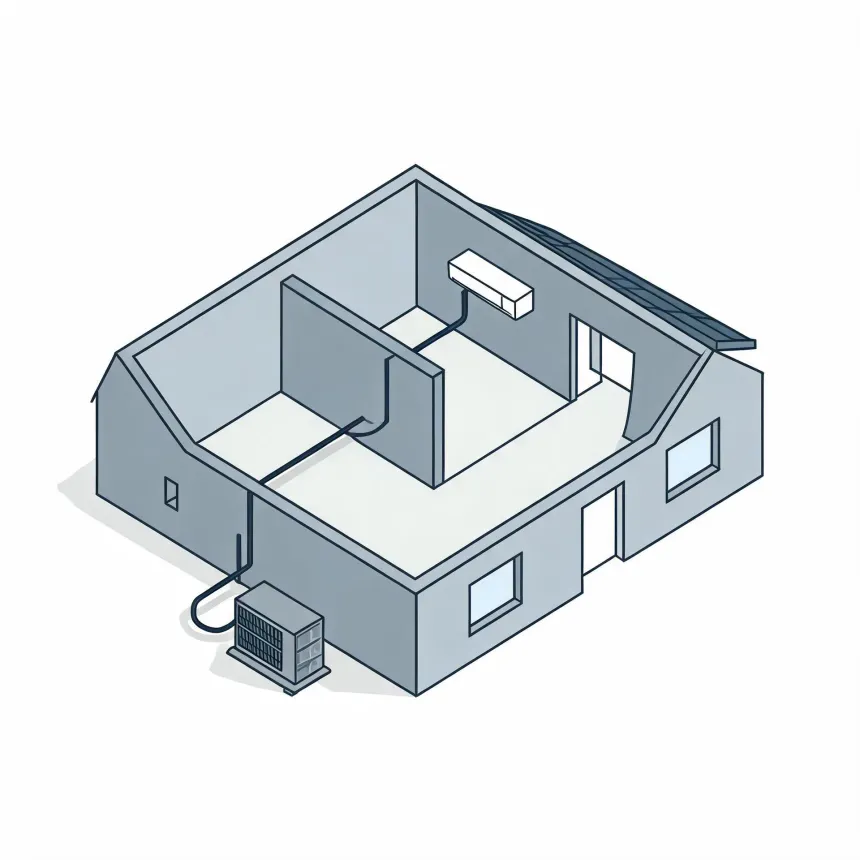
- A single outdoor unit can run one indoor head or several, depending on which system is installed. Single-zone systems cover one room or open area well. Multi-zone systems split the capacity of one outdoor unit across several indoor heads, so more zones means less capacity available per room. A contractor sizes the system to the rooms you want covered, not the other way around.
- Can a mini split heat a whole house?
- It can, if the system is sized and placed for the whole house rather than a room or two. That takes a heat pump rated for the coldest nights here, which average 34°F from December through February, and enough indoor heads to reach every room you want warm. Homes with open layouts do better with fewer zones than homes with many closed-off rooms. A contractor can walk the house and say what it would take to cover all of it.